Use
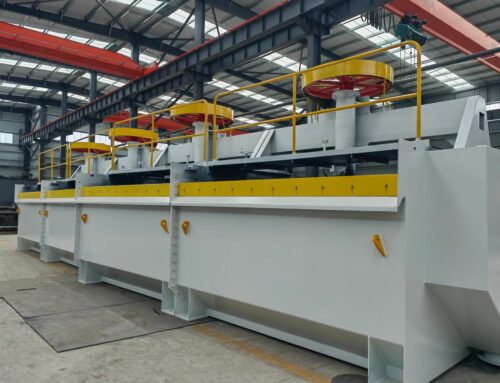
Flotation machine is suitable for separating and selecting metals (copper, gold, aluminum, silver, molybdenum, zinc, etc.) and ores, and it can also be used for non-metallic (coal, etc.) sorting. It has many advantages such as large inflatable volume, high working efficiency, low operation cost, stable mechanical performance, easy replacement of wearing parts and low maintenance cost. Common form of mechanical agitation flotation machine.
The working principle
Flotation machine is the mixing tank in the slurry sucked, with the help of the lower part of the tank stator impeller rotating centrifugal role (stator and impeller structure similar to the centrifugal pump). On the one hand, the slurry is fully stirred, on the one hand, a large amount of air from the suction pipe, and the air is broken into small bubbles. The useful mineral particles, under the action of the agent, adhere to the surface of the bubbles and float up to the surface of the slurry, forming a mineralized foam layer, which is scraped out of the flotation tank by the scraper and falls into the chute, while the tailings are discharged through the tail discharge pipe.
Structure
Tank body
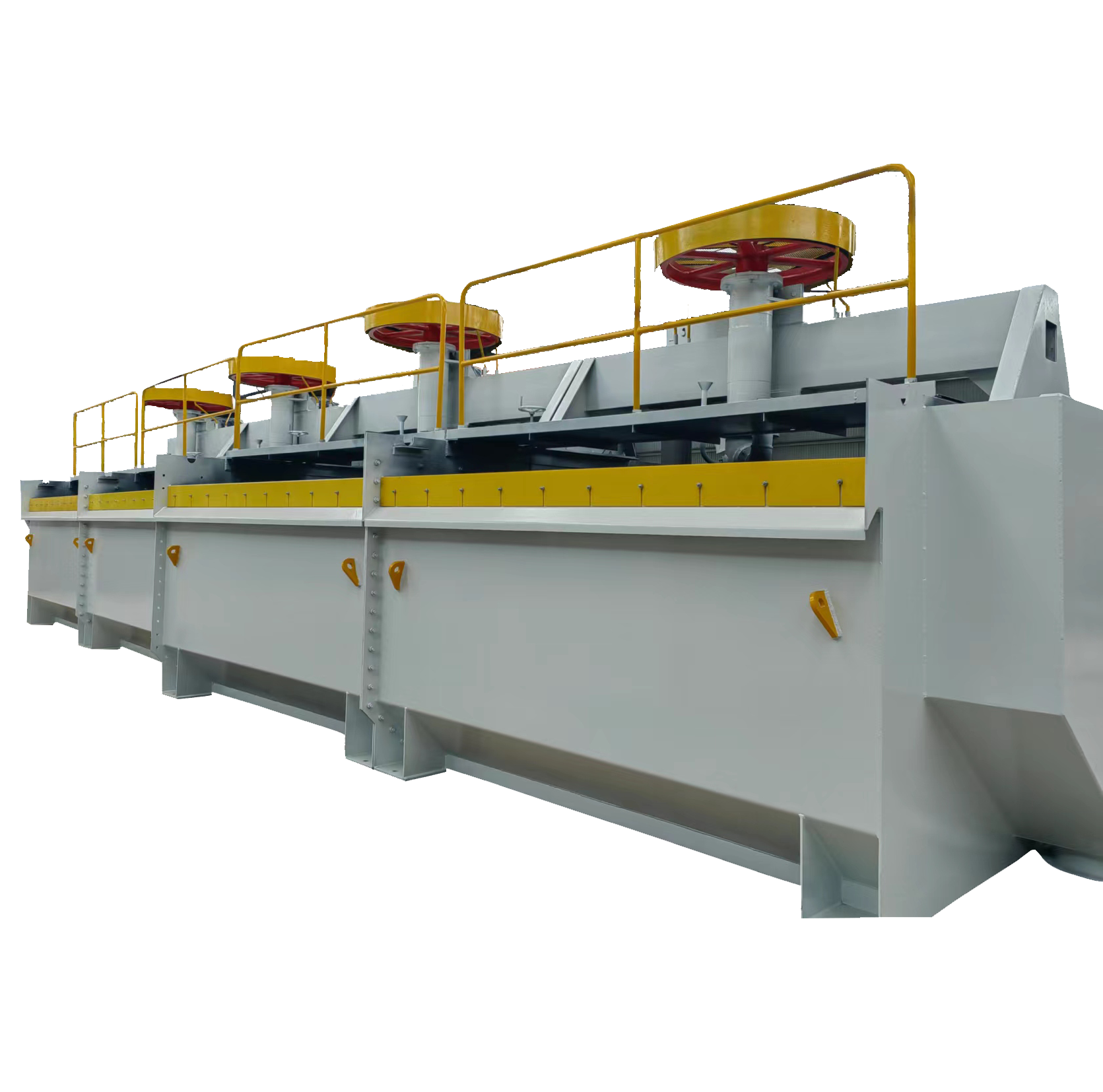
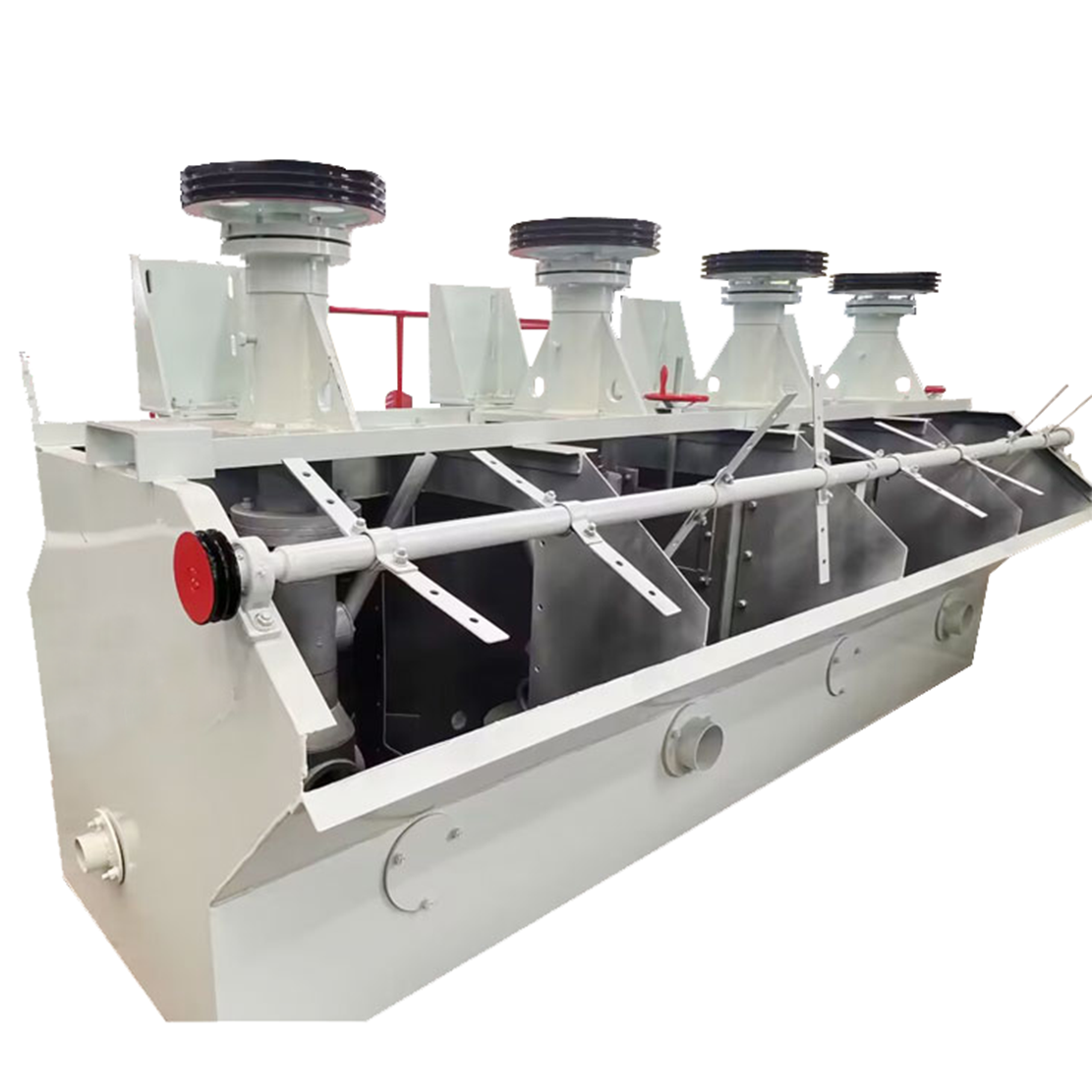
The flotation machine is horizontally arranged and divided into several tank areas. Each group of flotation machine should be pre-assembled before leaving the factory, and it can be shipped as one unit and assembled at the site. There are rubber gasket seals between the multiple tank areas.
Impeller part
The impeller part is the core of the flotation machine, which can simultaneously accomplish sucking slurry, sucking air, mixing air and slurry, as well as keeping the slurry in suspension. The axial and radial clearance between the impeller and stator directly affects the pulp suction, air suction and power consumption of the flotation machine.
After the flotation machine runs for a period of time, the impeller and stator edges will gradually wear out, which will cause the suction volume to drop and the working condition to deteriorate, and need to be replaced in time. This flotation machine adopts rubber-lined impeller and rubber-lined stator, which prolongs the service life of impeller and stator and improves the flotation conditions.
There is an oil cup at the upper and lower cone bearings of the impeller part, and grease is injected once a week.
Slurry water level adjuster
This machine adopts the method of controlling the flow of slurry to control the height of liquid level in each tank. Turning the handwheel of the slurry water level adjuster can change the relative position of the gate plate and the feeding pipe, thus changing the through-flow area of the feeding pipe and achieving the purpose of controlling the liquid level. The height of the liquid level of the flotation machine is an important parameter that affects the flotation effect.
Slurry water level blocker
It is installed between different tanks according to the process demand. It can stop the liquid level circulation between the tanks to meet the process demand.
Effect of flotation time
The time that the slurry stays in the flotation tank for each operation is called the flotation time, and there is a suitable flotation time for each type of ore, which needs to be determined based on the analysis of the ore. When the flotability of the mineral is better, the less the content of the mineral being floated. Flotation to the appropriate size of the ore, the slurry concentration is small, the stronger the role of the agent, the stronger the inflatable agitation, the shorter the flotation time.
The selection time is mainly based on the flotability of minerals and the requirements for concentrate quality. For example, graphite flotation, it needs to go through several selections to get high quality concentrate, and the selection flotation time is about 6-10 times of the roughing flotation time.
The relationship between flotation time and flotation indexes is mainly as follows: increasing the flotation time can increase the concentrate recovery rate, but the concentrate taste decreases. Recovery rate increases rapidly at the beginning of flotation, and with the extension of time gradually becomes slow until no longer increasing.
Slurry pH Adjustment
The pH of the slurry can affect the flotation properties of the mineral surface and various flotation effects. There is a critical pH value when using different flotation chemicals for flotation. Controlling the critical pH value can effectively control the separation of various minerals. So it is said that the control of pulp pH is one of the important initiatives of the flotation process.
Most sulfide ores in the flotation is basically in the alkaline or weakly alkaline pulp. Because acidic slurry has a corrosive effect on flotation equipment, and many flotation chemicals, such as xanthan, oleic acid, turpentine oil, etc., are more effective in weakly alkaline slurry.
Effects of slurry aeration and agitation
Aerating is mainly to send a certain amount of air into the slurry of the flotation machine, is the generation of a large number of dispersed micro-bubbles within the slurry, in order to facilitate the attachment of hydrophobic mineral particles to the surface of the bubbles.
The amount of air into the slurry is mainly related to the type of flotation machine and working system, for example, mechanical agitation type flotation machine inflation and agitation is occurring at the same time. The amount of air filling in addition to the demon is determined by the rotational speed of the impeller, the faster the impeller rotates, the greater the amount of air filling required. Slurry concentration on the flotation machine inflatable
The amount and the degree of air dispersion has a great influence on the flotation machine. Air in the flotation machine slurry dispersion degree also depends on the size of the bubble. The smaller the bubble, the better the air dispersion, and at the same time can increase the bubble surface and the opportunity to contact with the ore particles, is conducive to improving the flotation index. If the bubble is too small but harmful to flotation.
Agitation is mainly divided into two stages in the flotation process: agitation before the slurry enters the flotation machine and agitation after the slurry enters the flotation machine.
Stirring before the slurry enters the flotation machine mainly occurs in the stirring tank, the purpose is to accelerate the interaction between the ore particles and the chemicals. By the ease of dispersion of chemicals in water and the speed of their interaction with the ore particles to determine the length of agitation of the slurry in the agitation tank. Foaming agents such as turpentine oil need to be stirred for 1-2 minutes, and general chemicals need to be stirred for 5-15 minutes.
The agitation of the slurry into the flotation machine has three main roles: one is to promote the suspension of the ore particles and uniform dispersion in the tank; the second is to promote the uniform distribution of air in the tank, but also play the role of inflation; the third is to promote the air in the tank to accelerate the dissolution of high-pressure zone, accelerate the precipitation in the low-pressure zone, the formation of a large number of active air bubbles.
Aeration and agitation in the flotation process should be determined by ore dressing tests according to the type and structural characteristics of the flotation machine. Enhancing the aeration and agitation of the slurry in the flotation machine is favorable to flotation, but not too much. If excessive agitation and aeration will cause bubble merger, concentrate quality decline, slurry volume reduction in the tank, increased power consumption and mechanical wear and tear and other problems.
In addition to the above factors, there are other factors affecting the flotation effect, such as water quality, because flotation is carried out in aqueous media, the gas contained in the water, ions and some organic matter will affect the flotation process. Therefore, in the flotation process, various factors should be considered comprehensively, and the flotation process and technical parameters should be adjusted in real time according to the actual production situation, so as to avoid affecting the overall production speed of the plant and causing economic losses.
Difference between roughing and fining
Flotation machine flotation not only requires the minerals to be fully dissociated monomer, but also requires a suitable particle size. Mineral grains are too coarse, even if the minerals have been dissociated monomer, because more than the bubble flotation capacity, often can not float. Various types of minerals flotation particle size upper limit is different, such as sulfide minerals are generally 0.2-0.25 mm, non-sulfide minerals for 0.25-0.3 mm, for some of the density of smaller non-metallic ores such as coal, the upper limit of the particle size can be increased. However, the grinding particle size is too fine (such as less than 0.01 mm) is also unfavorable to flotation. Practice has proved that there are differences in the flotation behavior of various particle sizes. Different minerals have their own optimal flotation particle size range.
Under the premise of ore particle monomer dissociation, rough grinding flotation can save the grinding cost and reduce the beneficiation cost. When dealing with unevenly embedded ores and large porphyry copper ores, there is a tendency to flotation after rough grinding under the premise of ensuring roughing recovery. However, because the coarser ore particles are heavier, it is not easy to suspend in the flotation machine, the chance of collision with the bubble is reduced, and it is easy to fall off after attaching to the bubble due to the large shedding force. Therefore, coarse-grained ore particles in the general process conditions, the flotation effect is poor, in order to improve the flotation of coarse particles, the following special process conditions can be used.
Practice has proved that the strong turbulent movement of the slurry in the mechanical stirring flotation machine is the main factor that prompts the ore particles to fall off from the bubble. Therefore, reduce the turbulence intensity of the slurry movement is to ensure that the fundamental measures of coarse grain flotation.
Select the special flotation machine suitable for flotation of coarse grains. Improve and adjust the structure and operation of the conventional flotation machine, appropriately reduce the depth of the tank (shallow tank type), shorten the floatation distance of the mineralized bubbles, so as to avoid the shedding of mineral grains, in the impeller area above the addition of the grid sieve in order to weaken the turbulence intensity of the slurry to maintain a smooth foam area, increase the amount of gas, the formation of a larger number of large bubbles, which is conducive to the formation of gas bubbles and mineral grains composed of floating group, the coarse particles “arch lift” upward, scraping bubbles, and the formation of a large bubble. “Floating, scraping bubble should be rapid and smooth.
Appropriately increase the concentration of slurry, improve the pharmaceutical system: the selection of strong trapping power of the capture agent and a reasonable increase in the concentration of the agent, the purpose is to enhance the strength of minerals and bubbles of the adhesion to accelerate the speed of flotation, in addition to adding non-polar oil. Such as diesel oil, kerosene and other auxiliary recovery agents, can “consolidate” the three-phase contact perimeter, enhance the solidification of minerals and bubbles strength.
Understand the working principle of the flotation machine for daily production is very helpful, mainly can greatly reduce the failure rate of the flotation machine, but also to extend the service life of the flotation machine.